This website uses cookies to remember users and understand ways to enhance their experience. Some cookies are essential, others help us improve your experience by providing insight into how the site is used. For more information, please visit our Privacy policy
An embedded system is a small, dedicated computer built into a larger device to perform a specific task. These systems power everyday products and many IoT (internet of things) devices.
This guide explains what embedded systems are, how hardware and software work together, and what common terms really mean.
What are embedded systems?
Embedded systems are small computers built into a larger system to handle a dedicated function. Unlike apps on phones or laptops, embedded systems focus on one job and repeat it reliably. You find embedded systems inside everyday products, even when no screen or keyboard is visible.
In real devices, the “computer” part is usually a tiny board hidden inside the product. It contains a processor, memory, and basic input output support. This board monitors signals, makes decisions, and triggers actions without user attention. The rest of the product provides structure, power, and physical purpose.
Common examples of embedded systems include:
Washing machines controlling wash cycles and water flow
Digital thermostats regulating temperature
Printers managing paper movement and ink delivery
Vehicle dashboards displaying speed and warnings
Each example shows how embedded systems run as part of a larger system, not as standalone machines. They do not run many programs or switch roles. Instead, embedded systems are designed around specific tasks and predictable behavior.
This focus makes them efficient, stable, and suitable for products that must work the same way every time. A lot of embedded systems quietly support products people rely on daily.
How embedded systems differ from general-purpose computers
Embedded systems differ from general-purpose computers in how they are built and used.
A laptop is designed to run many programs, switch tasks, and adapt to changing user needs. Embedded systems exist inside a larger system and focus on one role.
The key differences include:
Purpose: embedded systems handle specific tasks, while general-purpose computers support many activities
Software: computers run full operating systems and application software; embedded systems use focused embedded system software
Resources: embedded systems limit memory, storage, and power consumption
Because embedded systems run under fixed conditions, they are optimized for reliability. They start quickly, respond predictably, and run for long periods without failure.
Many embedded systems are built for low maintenance and low power consumption. This efficiency matters in products that must stay on, work unattended, or meet safety requirements.
These constraints shape how embedded systems operate compared to flexible consumer computers. Reliability outweighs convenience in most embedded designs found in critical electronic systems today now.
Core components of embedded devices
Embedded devices are built from a few core parts that work closely together. In embedded systems, hardware and software are designed as one unit, not as separate layers. This tight link is what allows embedded systems to respond quickly and reliably inside a larger system.
Most embedded systems include:
System hardware made from processors, memory, and integrated circuits
Embedded software that defines how the device behaves
Input and outputconnections to interact with the environment
A stable power supply matched to the device’s role
Each part exists to support a specific job, not flexibility.
Hardware components inside embedded systems
Inside embedded systems, hardware is chosen to support one clear role. These parts form the electronic hardware that allows the system to sense, decide, and act within a larger system. Unlike flexible computers, these parts are selected to stay simple, stable, and efficient.
Key hardware parts include:
Microcontrollers combine a central processing unit, memory, and control logic on one chip, making them ideal for compact control systems
Microprocessors focus on raw processing, relying on separate components for memory and input output
Sensors detect physical changes, like temperature or motion, while actuators create physical responses, such as opening valves or moving motors
Memory uses memory chips and flash memory chips to store instructions and data
Peripheralinterfaces connect sensors, displays, and other devices
Together, these hardware elements support fast, predictable behavior. In embedded systems, the goal is steady operation and reliable response, not flexibility.
The hardware exists to serve the product’s purpose, quietly and continuously, often without user interaction. This is why hardware choices shape cost, size, and lifespan in embedded systems more than appearance or convenience.
Embedded software and firmware explained
Embedded software is the code that tells embedded systems how to behave. Firmware is a type of embedded system software that lives directly on the device. It starts when the device powers on and stays in place, controlling basic actions without user input. These components form a core part of IoT software development, since connected devices rely on embedded code to operate reliably.
This software links hardware and software so the device reacts correctly to real conditions. It reads signals, makes decisions, and triggers responses. Unlike application software on a computer, embedded software is built for stability and long runtimes.
Key roles of embedded software include:
Reading sensor data and digital signals
Managing control systems and timing
Handling input and output actions
Coordinating tasks with limited resources
Some embedded systems use a real-time operating system to manage tasks. An RTOS (real-time operating system) decides what runs first when timing matters. This is common in real-time embedded systems, where delays can cause errors.
The goal is predictable behavior, not speed. Software is written to match the device’s purpose and system hardware, ensuring reliable operation over long periods without frequent updates.
How embedded systems work step by step
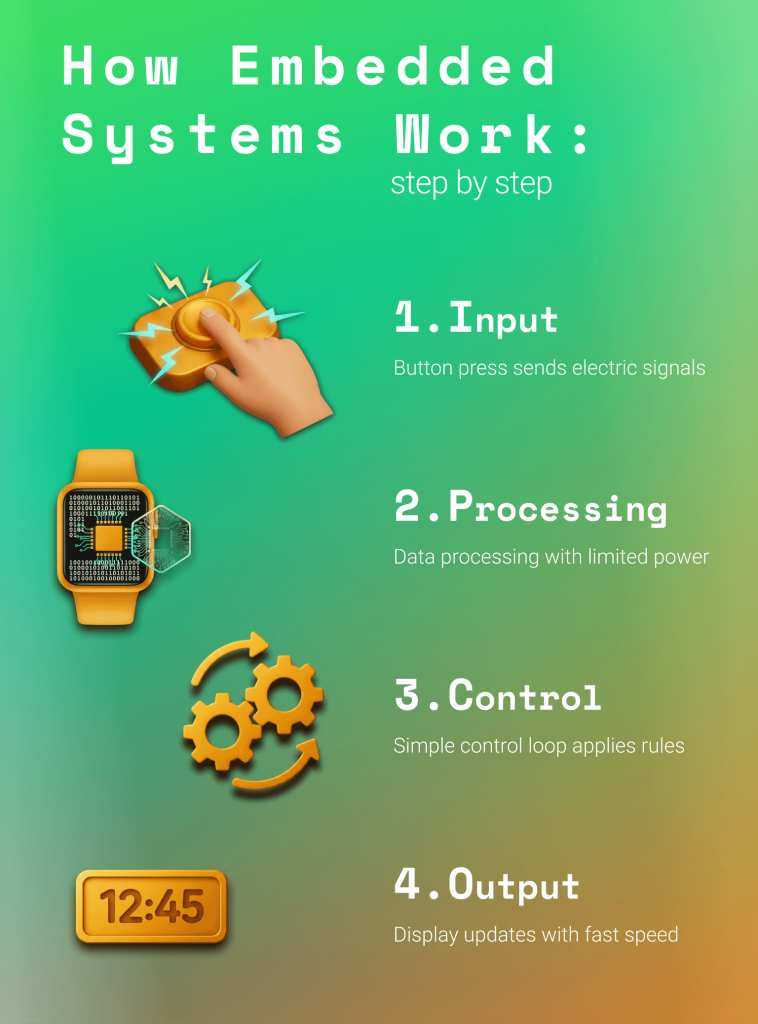
To understand how embedded systems operate, it helps to follow one simple example: digital watches. Inside the watch, the system repeats the same cycle from start to finish. This shows how embedded systems work in practice.
The basic steps are:
Input: buttons send electrical signals when pressed
Processing: the processor performs data processing using limited processing power
Control: internal control mechanisms apply a simple control loop
Output: the display updates with precise output generation speed
In this flow, the watch reacts instantly without running many programs. The logic is fixed and predictable. The software reads inputs, applies rules, and produces output. There is no multitasking like in a desktop computer.
This same pattern appears across embedded systems, from sensors to timers. Each cycle is designed to support one purpose inside a complete device. The system repeats this loop reliably for years during normal operation without user interaction required.
Types of embedded systems you should know
Embedded systems come in several forms, based on how and where they are used:
Standalone embedded systems run independently inside standalone devices. They perform fixed tasks without relying on external connections.
Networked embedded systems connect to other machines using wired or Wi-Fi networks. These systems share data and coordinate actions.
Mobile embedded systems operate inside portable devices and focus on efficiency and battery life.
Real time embedded systems react within strict time limits, where delays can cause failure.
Each type reflects how the system fits into its environment and workload.
Networked embedded systems in IoT products
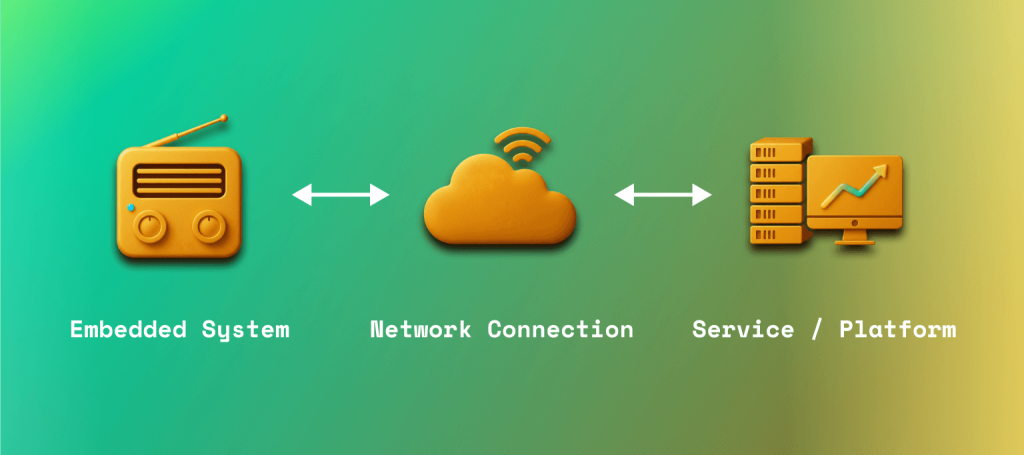
Networked embedded systems are embedded systems that connect to external services to exchange data. In everyday terms, this is what people usually mean when asking what is an IoT device. It is a physical product that contains embedded systems and can communicate beyond itself.
Connectivity allows devices to report status, receive updates, or respond to remote commands. Some products use cables, while others rely on wireless networks, depending on power limits and location. Both approaches fall under wired or wireless networks used by modern devices.
Once connected, embedded systems stop operating in isolation. They become part of a wider service that includes monitoring tools, dashboards, and other machines. This is how smart meters, trackers, and controllers stay useful after deployment.
To manage these connections, teams often reuse integration libraries. When developers ask what SDK is, they are referring to shared tools that simplify service access and reduce custom code. This work commonly falls to an embedded systems engineer.
Typical uses include:
Sending measurements to platforms
Receiving configuration changes
Coordinating behavior across networked embedded systems
Mobile embedded systems in everyday devices
Embedded systems inside portable products are designed to work within tight limits. Mobile embedded systems appear in mobile devices like fitness trackers, handheld scanners, and small controllers. These systems focus on size, battery life, and consistent behavior rather than flexibility.
Unlike general consumer computers, these devices rely on a compact power supply and carefully chosen components. Every part must fit into a small enclosure and operate for long periods without attention. Displays, buttons, or touch surfaces form a simple user interface that supports quick interaction.
Common characteristics include:
Small boards built around integrated memory and minimal storage
Limited input options connected to peripheral devices
Software written to reduce energy use and heat
A narrow task scope handled by reliable logic
Because space is limited, designers avoid unnecessary features. Processing, storage, and connectivity are kept lean. The goal is dependable operation in daily use.
These constraints shape how embedded systems are planned and tested. Wearables, handheld tools, and sensors depend on predictable behavior. In portable products, efficiency matters more than raw performance or visual complexity today.
Examples of embedded systems in real life
Embedded systems are often invisible, but they handle essential tasks in many products:
In medical devices, embedded control manages timing and alarms. This is common in medical equipment used for monitoring or treatment, where stable operation matters more than flexibility.
Inside household appliances, embedded logic controls heating, motors, and cycles. These systems quietly coordinate sensors and switches within larger electronic systems.
The Apollo guidance computer is an early example of embedded control. It handled navigation inside a spacecraft with limited resources and fixed behavior.
Some industrial machines now use IoT embedded systems to report status or receive updates, combining local control with remote access.
Many consumer products rely on embedded systems to manage buttons, displays, and internal timing without user setup.
These examples show how embedded control supports reliability and repeatable behavior across very different industries, without drawing attention to itself.
Designing embedded systems and development basics
Embedded systems design focuses on shaping a device around one clear job. Embedded system design starts by defining what the product must do, where it will operate, and how long it must run without failure. These decisions guide every technical choice.
When designing embedded systems, teams balance constraints rather than features. An embedded systems engineer looks at how parts fit into a larger mechanical product and how the system behaves over time.
Key areas considered include:
Hardware selection, including processors, integrated circuits, and memory layout
Software structure, covering logic flow and long-term software development needs
Testing under real conditions to confirm reliability
Development does not begin with code alone. Computer architecture choices affect cost, size, and future updates. Some projects require multiple processors, while others favor simplicity.
At a high level, embedded systems development is about alignment. Hardware, software, and testing exist to support the product’s purpose, not flexibility or expansion. This keeps designs focused, stable, predictable long term.
Embedded systems and IoT monetization opportunities
Embedded systems support connected products by handling data locally before anything leaves the device.
In standalone embedded systems, this logic runs entirely on hardware with no outside connection. When networking is added, devices can support IoT monetization to help offset long-term operating costs.
Not every product needs constant connectivity. Small-scale embedded systems, such as digital watches, rely on simple embedded software, read-only memory, and fixed behavior. Others grow into medium-scale embedded systems that share data through a standalone embedded systems network, while still working independently.
During IoT app development, teams decide how often devices communicate and what data matters. These choices shape app cost, reliability, and where the product fits in the embedded systems market.
An embedded systems engineer usually weighs this early, alongside software tools, programming languages, and integrated development environments used to develop embedded system software.
Key considerations include:
Keeping the user interface unchanged
Managing limits like required external memory or a field programmable gate array
Preserving timing guarantees in real time embedded systems
Some teams decide to add a background monetization option, like Honeygain SDK, for example. It can be an optional layer alongside existing strategies. It works quietly in the background and doesn’t interfere with core device logic.
These trade-offs often surface during an IoT platforms comparison, where sustainability matters more than short-term returns.
Key takeaways
Embedded systems are small computers built into products to perform focused, repeatable tasks.
Hardware and embedded software are designed together to support reliability, not flexibility.
Different forms exist, from standalone embedded systems to connected and real time embedded systems, depending on use.
Design choices are driven by the product’s purpose, limits, and environment.
An embedded systems engineer balances hardware constraints, software structure, and long-term stability.
FAQs
What is an embedded system with examples?
An embedded system is a small computer inside a product, built for one task. Examples include appliance controllers or sensors, usually created with basic software development tools tied closely to hardware.
What are three embedded systems?
A washing machine controller, a traffic light controller, and a fitness tracker. Each runs fixed logic for a specific role, sometimes written in constrained programming languages such as embedded Java.
Is Arduino an embedded system?
Arduino is not an embedded system itself. It is a development platform used to build embedded systems, combining a board, libraries, and common development tools for learning and testing.
What are the four types of embedded systems?
The four types are standalone, real-time, networked, and mobile. They differ by timing needs and connectivity, but all focus on predictable operation rather than general computing.